

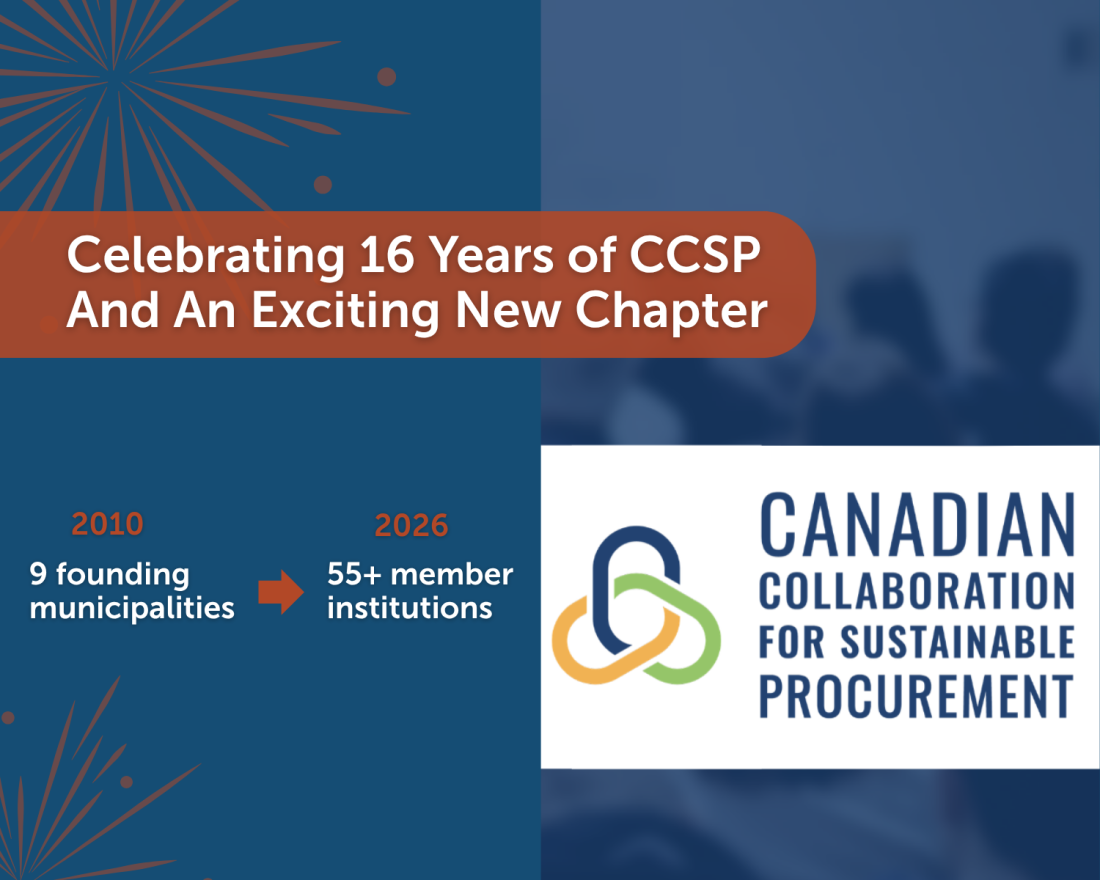
CCSP Celebrates 16 Years and a New Chapter
Celebrating 16 Years of Building Canada’s Sustainable Procurement Community
After 16 years of vision, growth, and national impact, the Canadian Collaboration for Sustainable Procurement (CCSP) has reached a major milestone: as of September 1, 2026, CCSP is now an independent registered Non-profit Society.
For Reeve Consulting, this transition is the culmination of a decade and a half of dedicated leadership. Having created, founded, and managed the network since its inception in 2010, Reeve Consulting has nurtured CCSP from a ground-up initiative into Canada’s largest national community of practice focused solely on all four pillars of sustainable procurement: environmental, social, Indigenous, and ethical.
How It All Began: Nine Municipalities and a Shared Vision
Reeve Consulting established the network in 2010 as the Municipal Collaboration for Sustainable Purchasing (MCSP), recognizing early on that public sector organizations could achieve far greater impact by collaborating than by working in isolation. Reeve brought together the initial cohort of nine pioneering municipalities, bringing the practical guidance and structure needed to turn sustainable purchasing into an actionable discipline.
With early leadership from Dan Lajeunesse (City of Edmonton) and Jeff Byrne (City of Ottawa), these founding members laid the foundation for peer exchange across the country. That same year, Reeve Consulting published Trends & Best Practices in Canadian Municipal Sustainable Purchasing, establishing ten key elements of successful programs that continue to guide the network’s mission today.
Over time, the network expanded beyond municipal government to include universities, Crown corporations, and health authorities. To reflect its growing scope, the network rebranded in 2020 as the Canadian Collaboration for Sustainable Procurement (CCSP). Today, it encompasses more than 55 public sector institutions dedicated to responsible sourcing and long-term value.
A New Chapter of Independence
Transitioning CCSP into an independent non-profit establishes a permanent governance structure designed to support its long-term growth.
As the program’s founder and manager throughout its entire 16-year journey, Reeve Consulting takes immense pride in leaving behind a strong, vibrant, and self-sustaining national community. This achievement reflects the collective effort of many key contributors:
- The original founding municipalities for their early vision.
- The member representatives who have generously shared their expertise and insights.
- The Reeve Consulting team, especially Amanda Chouinard, who played an essential role in managing and supporting CCSP’s growth.
CCSP’s independence is a testament to the strength, dedication, and collaborative spirit of its member community.
Celebrating Impact and Looking Ahead
Sustainable procurement is no longer an emerging trend; it is a core practice for public institutions across Canada.
To see how member organizations are turning sustainability commitments into measurable action, explore CCSP’s 2025 Annual Report, The State of Sustainable Public Procurement in Canada. The report highlights emerging trends, member achievements, and practical approaches to navigating complex environmental, social, Indigenous, and ethical priorities.
We look forward to seeing CCSP thrive in its next chapter as an independent leader in sustainable procurement.
Join the CCSP Network
If your organization wants to strengthen its sustainable purchasing practices, learn more about CCSP membership.

 Have you been wondering what other public sector organizations are doing to advance sustainable procurement – or what to do next in your own institution? Take a look at the Canadian Collaboration for Sustainable Procurement’s 2025 Annual Report on the State of Sustainable Public Procurement in Canada!
  The CCSP met for the 6th Peer Exchange of the year on October 19th, focussed on tracking and measuring social procurement KPIs.
  The CCSP was excited to kick off the second half of the 2023 programming on September 21st. In the spirit of the upcoming Truth and Reconciliation Day on September 30th, this month’s topic was Economic Reconciliation: Attracting Indigenous Suppliers.
 The CCSP sat for the fourth Peer Exchange of the year on June 22nd. In this session, members received a special update directly from the Federal Government on its new Standard on the Disclosure of GHG Emissions and Setting of Reduction Targets.
  The CCSP sat for the third peer exchange of the year on May 11th. This month’s topic: environmental impacts in construction. Read on to learn about certifications, lowering impacts of construction, embodied carbon, and some industry leaders in green building.
