All Posts

Modern high-rise residential towers beside a SkyTrain.

Community Benefits Beyond Construction: Lessons from Ashley Mar’s First Year of Operations

Modern high-rise residential towers beside a SkyTrain.

When a major development finishes construction, the community benefits it promised don’t have to end. Ashley Mar, a mixed-use project in Vancouver’s Marpole neighbourhood, shows how a Community Benefit Agreement (CBA) can keep delivering value once the cranes come down. 

The Project

Ashley Mar includes two towers with 524 market rental homes and a 125-unit co-op building. The project is led by Intracorp and Oxford Properties, with BGO Properties as property manager.

Why CBAs Matter

Introduced in 2018, the City of Vancouver’s CBA Policy ensures that major developments generate lasting local benefit. It sets three targets:

  • Local, inclusive employment: 10% of new entry-level jobs go to Vancouver residents, prioritizing equity-seeking groups.
  • Social procurement: at least 10% of materials, goods, and services come from social impact suppliers like businesses owned by equity-seeking folks.
  • Local procurement: at least 10% of goods and services come from Vancouver, Metro Vancouver, or BC-based businesses.

As third-party monitor, Reeve Consulting collects data from the property manager and contractors and reports to the City and the owners. 

The 2025-26 Results

In the reporting period ending June 30, 2026, Ashley Mar exceeded all three targets:

  • Inclusive hiring: Entry-level hires were made in roles such as concierge, security, and community management. 50% were equity-seeking Vancouver residents, and almost 10% were equity-seeking residents from elsewhere in Metro Vancouver.
  • Social procurement: 21.6% of spend went to social value suppliers, which is more than double the 10% target.
  • Local procurement: 89.5% of spend stayed within Metro Vancouver.

Social Procurement in Action

Blackstone Security team members standing together at an event.

Blackstone Security, a Metro Vancouver firm providing site security and concierge services, was one of the primary social impact suppliers. In addition to being minority-owned, Blackstone has built its workforce around opportunities for newcomers to Canada, BIPOC individuals, and members of the LGBTQ+ community. It offers flexible scheduling, mentorship, and support toward professional certification. This is the CBA’s intent in practice: procurement spend that creates employment pathways for people who face barriers.

What This Means for Procurement Leaders

Reeve Consulting’s work with Ashley Mar offers three takeaways for public and private buyers:

  1. Plan for the operations phase early. Reporting systems, contractor onboarding, and supplier relationships need attention well before occupancy.
  2. Make compliance easy. Simpler forms, short training, and privacy-protective tools improve data quality and ease participation.
  3. Treat targets as a floor. Exceeding the targets is rewarding, but additional value comes from diversifying and engaging with the supplier base over time.

At Reeve Consulting, we help public and broader public sector organizations embed sustainability and social value into procurement. Having monitored this project from construction through occupancy, we’ve seen how CBA outcomes evolve across a project’s lifecycle and what it takes to sustain them. Ashley Mar shows what is possible when that commitment continues beyond construction.

Interested in building social value into your procurement? Get in touch with our team.

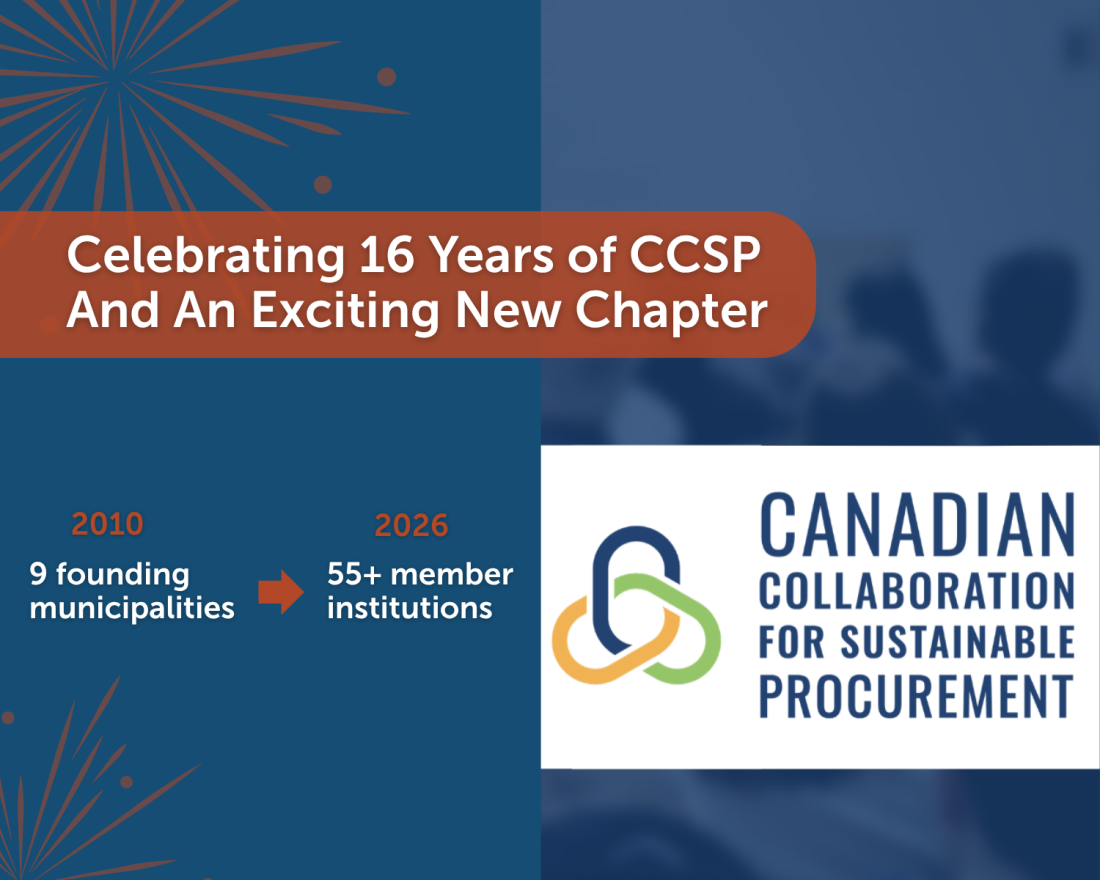
CCSP Celebrates 16 Years and a New Chapter

Celebrating 16 Years of Building Canada’s Sustainable Procurement Community

After 16 years of vision, growth, and national impact, the Canadian Collaboration for Sustainable Procurement (CCSP) has reached a major milestone: as of September 1, 2026, CCSP is now an independent registered Non-profit Society.

For Reeve Consulting, this transition is the culmination of a decade and a half of dedicated leadership. Having created, founded, and managed the network since its inception in 2010, Reeve Consulting has nurtured CCSP from a ground-up initiative into Canada’s largest national community of practice focused solely on all four pillars of sustainable procurement: environmental, social, Indigenous, and ethical.

How It All Began: Nine Municipalities and a Shared Vision

Reeve Consulting established the network in 2010 as the Municipal Collaboration for Sustainable Purchasing (MCSP), recognizing early on that public sector organizations could achieve far greater impact by collaborating than by working in isolation. Reeve brought together the initial cohort of nine pioneering municipalities, bringing the practical guidance and structure needed to turn sustainable purchasing into an actionable discipline.

With early leadership from Dan Lajeunesse (City of Edmonton) and Jeff Byrne (City of Ottawa), these founding members laid the foundation for peer exchange across the country. That same year, Reeve Consulting published Trends & Best Practices in Canadian Municipal Sustainable Purchasing, establishing ten key elements of successful programs that continue to guide the network’s mission today.

Over time, the network expanded beyond municipal government to include universities, Crown corporations, and health authorities. To reflect its growing scope, the network rebranded in 2020 as the Canadian Collaboration for Sustainable Procurement (CCSP). Today, it encompasses more than 55 public sector institutions dedicated to responsible sourcing and long-term value.

A New Chapter of Independence

Transitioning CCSP into an independent non-profit establishes a permanent governance structure designed to support its long-term growth.

As the program’s founder and manager throughout its entire 16-year journey, Reeve Consulting takes immense pride in leaving behind a strong, vibrant, and self-sustaining national community. This achievement reflects the collective effort of many key contributors:

  • The original founding municipalities for their early vision.
  • The member representatives who have generously shared their expertise and insights.
  • The Reeve Consulting team, especially Amanda Chouinard, who played an essential role in managing and supporting CCSP’s growth.

CCSP’s independence is a testament to the strength, dedication, and collaborative spirit of its member community.

Celebrating Impact and Looking Ahead

Sustainable procurement is no longer an emerging trend; it is a core practice for public institutions across Canada.

To see how member organizations are turning sustainability commitments into measurable action, explore CCSP’s 2025 Annual Report, The State of Sustainable Public Procurement in Canada. The report highlights emerging trends, member achievements, and practical approaches to navigating complex environmental, social, Indigenous, and ethical priorities.

We look forward to seeing CCSP thrive in its next chapter as an independent leader in sustainable procurement.

Join the CCSP Network

If your organization wants to strengthen its sustainable purchasing practices, learn more about CCSP membership.

Supplier Consolidation: A High-Impact Sustainable Procurement Strategy

Fashion brands are rethinking how many suppliers they actually need.

A recent industry report found that apparel companies intend to consolidate their sourcing networks over the next two years, moving away from fragmented supplier bases and toward fewer, deeper relationships.

At first glance, supplier consolidation appears to be primarily a cost-saving and risk-management strategy. But viewed through a sustainable procurement lens, it may also be one of the most important opportunities available to procurement teams today.

At Reeve Consulting, we refer to opportunities like these as High Impact Procurement Opportunities (HIPOs): areas of spend and supplier engagement where focused effort can generate a disproportionate improvement in sustainability performance, compliance readiness and risk reduction. Learn How To Create Your Own HIPO List For Your Organization Here!

Supplier consolidation can be a textbook HIPO. But it must be approached carefully. Done well, it can improve supply chain visibility and create stronger supplier partnerships. Done poorly, it can concentrate operational risk and create new blind spots.

What is supplier consolidation?

Supplier consolidation is the practice of reducing the number of suppliers used within a procurement category and concentrating spend among a smaller group of strategically selected partners.

The objective is not simply to remove suppliers. It is to build a more manageable supply base that enables an organization to:

  • Improve visibility into supplier operations
  • Strengthen strategic supplier relationships
  • Reduce administrative complexity
  • Conduct more meaningful due diligence
  • Coordinate sustainability improvements
  • Increase purchasing leverage
  • Monitor performance more consistently

These benefits are especially relevant in high-volume or high-impact categories where procurement teams may otherwise struggle to engage hundreds of suppliers with sufficient depth.

How supplier consolidation can improve supply chain visibility

Many organizations have reasonable visibility into their direct, or Tier 1, suppliers. That visibility tends to deteriorate rapidly further upstream, even though significant environmental and labour risks may exist at the Tier 2 and Tier 3 levels.

The 2026 EcoVadis and Accenture Sustainable Procurement Barometer illustrates this gap. According to the study, 48% of surveyed organizations have visibility into the sustainability performance of at least 75% of their Tier 1 suppliers. Only 12% report that level of visibility at Tier 2.

For many organizations, Tier 3 remains almost entirely opaque.

This visibility gap matters because businesses are facing increasing expectations to understand and substantiate what happens across their supply chains.

Canada’s Fighting Against Forced Labour and Child Labour in Supply Chains Act requires covered entities to report on the steps they have taken to assess and manage forced- and child-labour risks. Canadian businesses making environmental claims must also be able to support those claims under the Competition Act’s provisions addressing misleading environmental representations. The Competition Bureau’s current guidance emphasizes that businesses need evidence to support certain environmental claims.

Put simply, organizations cannot credibly manage—or report on—supply chain conditions they cannot see.

A more focused supplier network can help close that gap. Managing 15 strategic fabric mills instead of 150 dispersed vendors can make supplier assessments, deeper-tier mapping, audits and joint improvement plans operationally achievable.

Turning Tier 1 suppliers into sustainability stewards

The strategic value of supplier consolidation goes beyond purchasing leverage.

Organizations can give retained Tier 1 suppliers a more active role in monitoring and improving sustainability performance across the upstream supply chain. These suppliers may serve as regional or category stewards, with responsibility for engaging a defined group of Tier 2 and Tier 3 suppliers.

Depending on the category, that responsibility could include:

  • Mapping upstream suppliers and production sites
  • Collecting environmental and labour data
  • Communicating supplier requirements
  • Coordinating corrective-action plans
  • Supporting training and capability building
  • Escalating material risks
  • Tracking progress against shared performance targets

This creates a mechanism for sustainability expectations to move beyond the immediate contractual relationship.

The principle is straightforward: procurement teams do not need to engage every supplier with equal intensity. They need to identify the suppliers and categories carrying the greatest risk or impact, focus resources accordingly, and establish a credible way for that engagement to cascade upstream.

Organizations such as AstraZeneca and Schneider Electric have demonstrated versions of this targeted approach. Rather than attempting identical engagement across their entire supplier bases, they concentrated resources on suppliers representing the greatest share of spend or supply chain emissions.

That is the HIPO mindset in practice: prioritize the supplier relationships where deeper engagement can produce the greatest result.

The risks of supplier consolidation

Supplier consolidation is not automatically sustainable, resilient or responsible. Reducing supplier numbers introduces several important trade-offs.

Concentration risk

Fewer suppliers can mean greater exposure to a disruption at any one supplier. A factory closure, labour dispute, geopolitical event or climate-related disaster may affect a much larger share of an organization’s operations.

Procurement teams must therefore assess whether the benefits of improved visibility outweigh the loss of diversification. Where concentration risk is significant, organizations may need dual-sourcing arrangements, geographic diversification, contingency inventory or qualified backup suppliers.

Conflicts in delegated oversight

Asking a Tier 1 supplier to monitor its own upstream network creates a potential conflict of interest. The supplier has a commercial incentive to present its performance, and the performance of its partners, in a favourable light.

Delegated stewardship should therefore be supported by clear evidence requirements, third-party sustainability ratings, independent audits and periodic verification. Supplier self-reporting can inform due diligence, but it should not be the only source of assurance.

Continuing legal accountability

An organization does not transfer its legal or reputational responsibility simply by assigning monitoring activities to a supplier.

Under Canada’s supply chain reporting regime and other due diligence frameworks, covered organizations remain responsible for their own reporting and risk-management decisions. Supplier oversight must therefore form part of the organization’s governance system, and not just replace it.

Poor category fit

Supplier consolidation is not equally appropriate for every procurement category.

It is generally better suited to high-volume, high-impact and relatively standardizable categories, such as core fabrics, common components or repeatable production inputs.

It may be less appropriate where:

  • A category is low-volume but operationally critical
  • Supply is geographically concentrated
  • Demand changes quickly
  • Innovation depends on supplier variety
  • Switching suppliers is difficult
  • A disruption could stop essential operations

The decision should be made not through a blanket company-wide supplier reduction target, but at the category level, based on sustainability impact, market conditions and operational risk.

A practical supplier consolidation framework

Before consolidating a category, procurement teams should consider five questions.

1. Where is the greatest impact or exposure?

Evaluate categories using spend, environmental impact, human-rights risk, operational importance and regulatory exposure. This identifies where deeper supplier engagement is most likely to deliver meaningful results.

2. Which suppliers are genuinely strategic?

Assess more than price and volume. Consider performance, transparency, geographic exposure, sustainability capability, willingness to collaborate and ability to manage upstream relationships.

3. What risk would consolidation create?

Model the operational consequences of supplier failure or disruption. Identify where backup capacity, regional diversification or alternative sourcing arrangements remain necessary.

4. What stewardship responsibilities should retained suppliers hold?

Define expectations for upstream mapping, data collection, corrective actions, reporting and escalation. These responsibilities should be reflected in contracts, scorecards and supplier governance processes.

5. How will information be verified?

Determine which information can be supplier-reported and where third-party assessments, audits or independent evidence are required. Verification should be proportionate to the risk and significance of the claim or decision.

Why supplier consolidation matters now

Procurement teams are being asked to respond to several pressures at once: cost volatility, supply disruption, human-rights risks, environmental expectations and growing scrutiny of sustainability claims.

A fragmented supplier base can make each of these challenges harder to manage.

Supplier consolidation offers a practical way to focus limited procurement and sustainability resources. When paired with strong supplier governance, independent verification and category-level risk analysis, it can support:

  • Better supply chain visibility
  • More credible due diligence
  • Stronger sustainability data
  • Improved supplier performance
  • More defensible environmental claims
  • Greater compliance readiness

The organizations making progress are not necessarily those with the largest number of sustainability commitments. They are the ones that know where their highest-impact procurement decisions sit—and have built their programs around them.

If your organization is reconsidering its supplier base for cost, resilience, compliance or sustainability reasons, Reeve Consulting can help identify your High Impact Procurement Opportunities and develop a responsible supplier-consolidation strategy.

Contact Reeve Consulting to start the conversation today.

Source links

Woman and man picking up trash and cleaning the beach

Beyond the Cleanup: How Sustainable Procurement Creates Healthier Oceans

Woman and man picking up trash and cleaning the beach

Every year, Reeve Consulting’s shoreline cleanup fundraiser brings together clients, partners, colleagues, and friends for an evening of community action, meaningful conversations, and environmental impact. What began as a simple way to give back has become one of our favourite traditions, and this year, we’re excited to continue it alongside our longtime partner, Fairware.

Why a Shoreline Cleanup?

At first glance, a shoreline cleanup fundraiser may seem far removed from the world of sustainable procurement. In reality, they’re closely connected. 

The items we collect along shorelines often begin their journey much earlier in the supply chain. Packaging, single-use products, promotional items, and other materials are designed, sourced, purchased, distributed, and eventually discarded.  

According to the OECD, global plastic waste generation more than doubled between 2000 and 2019, reaching over 350 million tonnes. Roughly two-thirds of this waste comes from products with lifespans of less than five years.  

When waste escapes collection systems, it can end up in rivers, coastlines, and oceans. The United Nations estimates that approximately 11 million tonnes of plastic enter aquatic ecosystems each year. Without significant action, that figure could nearly triple by 2040. 

Better Purchasing Decisions Create Better Outcomes   

This is where sustainable procurement makes a difference. 

When organizations choose durable products, reduce unnecessary packaging, prioritize reusable or circular solutions, and work with responsible suppliers, they help prevent waste before it ever reaches a shoreline.

Sustainable procurement is about looking beyond the point of purchase and understanding the full lifecycle of products and services. It helps organizations create positive environmental, social, and economic outcomes while building more resilient and responsible supply chains.

It’s why this fundraiser matters so much to us. At Reeve, we spend our days helping organizations make more sustainable purchasing decisions. Taking the time to collect litter provides a tangible reminder of why upstream decisions matter. It’s an opportunity to see the real-world consequences of waste while connecting with others who share a commitment to creating positive change.

Why Reeve Supports Ocean Wise

This year, proceeds from the event will support Ocean Wise, a Vancouver-based and globally recognized conservation organization dedicated to protecting and restoring ocean health.

We chose to support Ocean Wise because of its practical, science-based approach to conservation and its deep roots in the communities where we live and work. Through research, education, shoreline restoration, pollution prevention initiatives, and public engagement, Ocean Wise helps address some of the most pressing challenges facing our oceans today.

Their work goes beyond responding to environmental issues after they occur. Like sustainable procurement, it focuses on prevention, long-term thinking, and creating systems that support healthier outcomes over time. That alignment makes Ocean Wise a natural partner for this event and a cause we are proud to support.

Join Reeve’s Shoreline Cleanup Event

Reeve Consulting and Fairware teams at Third Beach for Shoreline Cleanup

Of course, the shoreline cleanup is also about bringing people together.

Whether you are a longtime sustainability champion, a sustainability professional looking to expand your network, or simply someone who wants to spend a summer evening making a positive impact, we would love to have you join us.

Participants can expect a hands-on cleanup, great conversations, food and drinks, and the opportunity to connect with sustainability professionals, business leaders, and community members who share a commitment to making a difference.

Together, we can help keep our local shorelines clean, support the important work of Ocean Wise, and continue building a future where responsible decisions create positive impacts for people and the planet.

Join us at Hinge Park on July 23 for an evening of community, connection, and action. Every piece of litter collected and every ticket purchased helps support healthier oceans and a more sustainable future.

Get your ticket here: https://www.eventbrite.com/e/reeve-x-fairware-shoreline-cleanup-2026-registration-1988037344213

Reserve your spot today and help turn sustainable values into meaningful action.

Man and woman walking through factory, looking at tablet and checklist

EcoRFx: Sustainable Procurement Software for RFPs | Reeve Consulting

A man and woman reviewing procurement in a warehouse

Every supplier evaluation starts with the same challenge: determining which sustainability criteria actually matter for a specific procurement requirement.

Too often, procurement teams are forced to choose between generic templates that don’t reflect the realities of the category being purchased or relying on sustainability specialists to guide every decision. The result can be inconsistent evaluations, lengthy approval processes and unnecessary pressure on sustainability teams with limited capacity.

After years of helping organizations embed sustainability into procurement processes, Reeve Consulting noticed the same challenge appearing again and again. Procurement professionals needed a practical way to identify the right sustainability requirements quickly, confidently, and consistently.

That’s why we’re excited to introduce EcoRFx, a new platform that transforms Reeve’s sustainable procurement expertise into an easy-to-use tool for procurement teams.

Why Sustainability Requirements Are So Difficult to Define

Every procurement category comes with unique sustainability considerations.

The questions that matter when purchasing IT equipment are very different from those required for construction projects, professional services, fleet vehicles, or facilities management. At the same time, organizations must navigate Canada’s Fighting Against Forced Labour and Child Labour in Supply Chains Act (formerly Bill S-211), Indigenous procurement targets, organizational ESG commitments, supplier expectations, and reporting requirements.

Without a structured approach, procurement teams can face several common challenges:

  • Spending hours researching sustainability requirements for every RFP.
  • Using outdated or generic question libraries.
  • Creating bottlenecks by requiring sustainability team involvement in every procurement decision.

Organizations need a way to move faster without sacrificing rigour.

Introducing EcoRFx

EcoRFx platform

EcoRFx helps procurement teams identify and prioritize the sustainability questions that matter most for each procurement requirement.

Based on the category, procurement type, and geography of each requirement, EcoRFx builds a tailored set of sustainability priorities. Once adjusted to fit the project, those priorities turn into a full set of supplier evaluation questions, ready to export and use.

Rather than starting from a blank page or waiting on someone else’s input, teams begin with a structured, defensible framework — ready to customize for each procurement process.

Every question also includes a documented rationale explaining why the requirement is relevant, along with evaluation guidelines to help procurement teams assess supplier responses. This gives teams the context to use those questions confidently and justify their choices when needed.

From Blank Page to Issued RFP in Under 15 Minutes

EcoRFx is designed to reduce the time and effort required to build sustainability requirements into procurement processes, giving teams a structured starting point instead of asking them to research and build requirements from scratch.

What Your Team Walks Away With

Bid-ready questions

Sustainability questions curated for your procurement category and ready to export into your RFP or procurement documents.

Defensible documentation

Documented rationales provide a clear record that can be shared with sustainability teams, leadership and auditors when teams need to explain why requirements were included.

A reusable template library

Start saving and reusing procurement requirements and organizational knowledge so teams don’t have to reinvent the process for every RFP. This way valuable knowledge stays within the organization as teams change.

Procurement independence

Give procurement professionals the tools and guidance to move projects forward without escalating every procurement decision to a sustainability specialist.

More Than a Question Generator

EcoRFx brings your sustainable procurement workflow together in one platform, with tools designed to support teams throughout the procurement process, including:

Question Generator & Evaluation Criteria

Generate sustainability questions tailored to the procurement and access guidance for evaluating supplier responses.

Relevant Ecolabels & Specifications

Identify ecolabels, certifications and specifications relevant to the procurement category.

Procurement Manager

Manage sustainable procurement requirements and projects through a structured workflow.

Organization Library

Build a reusable source of organizational procurement knowledge, requirements and templates.

Export Engine

Turn completed requirements and evaluation criteria into documentation ready to use in the procurement process.

Chatbot Assistant

Get additional guidance and support while working through sustainable procurement requirements.

Together, these tools help organizations move away from fragmented spreadsheets, generic question libraries and one-off processes toward a more consistent approach to sustainable procurement.

Turning Consulting Expertise Into a Practical Tool

EcoRFx is built by Reeve Consulting, a Canadian sustainable procurement advisory with more than two decades of experience helping organizations integrate sustainability into purchasing decisions.

The platform brings together the frameworks, question libraries, evaluation methodologies, and procurement insights refined through years of client engagements and hundreds of supplier evaluations.

By transforming that experience into a digital platform, EcoRFx makes Reeve’s sustainable procurement expertise more accessible to procurement teams and easier to apply across an organization.

Built on Reeve’s Four Pillars of Sustainable Procurement

The four pillars of sustainability, ethical. indigenous, social and environmental

At the core of EcoRFx is Reeve Consulting’s Four Pillars framework, developed through years of supporting public and private sector organizations across Canada.

1. Ethical

Evaluate governance practices, labour standards, transparency, and responsible business conduct.

2. Indigenous

Advance Indigenous participation and help organizations align with Indigenous procurement commitments, and reconciliation objectives.

3. Social

Support community benefits, workforce wellbeing, diversity, equity, and broader social outcomes.

4. Environmental

Address carbon emissions, resource use, waste reduction, circular economy considerations, and environmental performance.

Together, the four pillars help teams consider sustainability from multiple perspectives while focusing on the issues most relevant to each procurement.

Sustainable Procurement Without Starting From Scratch

EcoRFx isn’t designed to replace sustainability expertise. It’s designed to make that expertise easier to apply. Procurement teams gain a structured way to:

  1. Determine what matters
  2. Understand why it matters
  3. Evaluate supplier responses, and
  4. Document their decisions. 

Sustainability professionals, in turn, can focus their time on higher-risk or more complex  decisions without adding unnecessary complexity to the process.

The result is a practical way to bring more sustainability into more procurement decisions – from blank page to issued RFP – in as little as 15 minutes!

Explore EcoRFx

If your organization is looking to standardize sustainability requirements and strengthen procurement outcomes, visit EcoRFx to explore the platform and learn more.

See how EcoRFx works –>

CCSP Annual Report 2025

Sustainable Public Procurement in Canada 2025: Trends, Insights & CCSP Report

CCSP releases its 16th Annual Report: The State of Sustainable Public Procurement in Canada

CCSP Annual Report 2025Have you been wondering what other public sector organizations are doing to advance sustainable procurement – or what to do next in your own institution? Take a look at the Canadian Collaboration for Sustainable Procurement’s 2025 Annual Report on the State of Sustainable Public Procurement in Canada! 

Download from here

Drawing on the hard work and success stories of the CCSP’s network of 57 member institutions from coast to coast, this report highlights national sustainable procurement trends, showcases CCSP member accomplishments, and features success stories from across Canada throughout 2025.

Amid the pressures of tariffs and tightening budgets, a roll-back on EDI south of the boarder, and increasing legislation, procurement teams stayed the course. We saw lots of work going towards adopting or renewing sustainable procurement action plans, engaging with suppliers, updating RFP tools and procedures, and training internal audiences.  

What’s in this years’ report?

The report highlights emerging and evolving trends, best practices in sustainable public procurement, and profiles developments and success stories from CCSP members. You can find our guiding 10-point Best Practice Framework for a high-performing program on page 14.

2025 Trends in Sustainable Procurement – We’ve highlighted ten key trends shaping sustainable purchasing this year. These include strengthening local supply chains in the face of tariffs, refining sustainability questions in RFPs, new work on integrating sustainability into vendor performance management and modern slavery due diligence, maintained focus on social and Indigenous procurement, and a need for more meaningful action as progress on climate and circularity slows. 

Member Benchmarking and Program Developments – Wondering how our members become sustainable procurement champions? We conducted benchmarking interviews to support members in assessing their progress on implementing the Best Practice Program Framework. Head to this section to see the ever-popular Moon Chart Ratings for each member and their main program developments across the 10 Program Elements. 

Member Success Stories – We’re all about celebrating the successes of CCSP members, and this year we’ve shared inspiring stories of how they’re embedding sustainability into real procurement decisions. From UBCO advancing sustainable custodial services, to the City of Brampton supporting Diverse suppliers, City of Mississauga sourcing sustainable coffee services, and City of Winnipeg working with an Indigenous supplier — we love seeing our members “do the doing” in sustainable procurement. Explore this section to read more real-world examples.

2025 CCSP Operations – This section of the Report provides an overview of the sectors in which our network operates, the geographic distribution of our members across the country, and other program activities that took place in 2025.

We hope you join us in celebrating the successes and hard work of the CCSP members and share this report far and wide! Please navigate to our ABOUT CCSP page to download the full report. 

It’s not too late to join the 2026 CCSP Program!

Contact Amanda Chouinard, Program Manager, at ccsp@reeveconsulting.com if you’re interested in learning more.  

CCSP members have access to a community of practice with peer organizations who have similar goals to align their sustainability values with their purchasing practices, including educational webinars, a Resource Library, and one-on-one support. 

Crowd cheers on at FIFA World Cup

The World is Watching: Are Supply Chains Ready for Sustainable Procurement at Mega Events?

Crowd at stadium cheering on the World Cup


The global sporting calendar between 2025–2027 is one of the most ambitious yet. Super Bowl LIX drew over 100 million viewers in February 2025. The Milano Cortina 2026 Winter Olympics will be the first to follow the IOC’s reformed Olympic Agenda. FIFA World Cup 2026 (hosted across North America, including Vancouver) will be the largest in history. And preparations are already underway for the Los Angeles 2028 Summer Olympics.

Each of these events commands billions in procurement spend. They mobilize vast supplier networks and reshape host city infrastructure. For corporate sustainability leaders, this scale represents not just risk, but a powerful opportunity to drive sustainable procurement in major events.

Sustainable procurement refers to purchasing decisions that consider environmental, social, and economic impacts. Not just cost.

The Climate Impact of the Global Sports Industry

Sport is big business, and continues to grow. A 2026 report by Oliver Wyman and the World Economic Forum projects the global sports economy will expand from $2.3 trillion to $8.8 trillion by 2050. However, climate and nature risks could put up to $517 billion in revenue at risk by 2030.

The environmental footprint of major sporting events is significant. A Cardiff University study found that the average event attendee generates an environmental footprint seven times greater than normal daily activity, largely due to travel. At scale, the numbers become staggering. By 2022, business travel accounted for 72.3% of the Olympics’ total carbon footprint.

Infrastructure decisions add further impact. South Korea dismantled a $110 million stadium shortly after the 2018 Winter Olympics. Meanwhile, rising heat, extreme weather, and pollution are already disrupting events and straining infrastructure.

The irony is hard to ignore: the same industry threatened by climate change is also contributing to it. But this also signals a major opportunity, specifically for sustainable procurement at major events.

A Global Platform for Sustainable Procurement Stories

Mega sporting events are not just environmental challenges, they are global communication platforms. Billions of viewers tune in, yet sustainability efforts are rarely highlighted.

There are strong examples however. Vancouver 2010 incorporated recycled metals into Olympic medals. Tokyo 2020 created all medals from recycled electronics, collecting over 47,000 tonnes of materials. London 2012 achieved zero waste to landfill and created one of Europe’s largest new urban parklands.

These achievements are significant, but largely unknown. When sustainability initiatives are integrated into storytelling, they normalize better practices at scale.

The goal should not only be to reduce harm. It should be to demonstrate what better looks like – and make it visible.

Why Sustainable Procurement Matters in Major Sporting Events

When billions of dollars move through a single organizing committee, procurement becomes a critical lever. Every purchasing decision shapes environmental and social outcomes.

Done well, sustainable procurement in major events supports low-carbon materials, inclusive employment, and stronger local economies.

Milano Cortina 2026 provides a strong example. Its Impact 2026 programme directs contracts to local and social enterprises. Over €1.77 million has already been awarded across 76 contracts, and more than 400 companies have received training.

This combination of economic resilience and social inclusion reflects the core goal of sustainable procurement strategies.

How to Embed Sustainable Procurement from the Start

Effective strategies are not added after contracts are signed—they are built in from the beginning. This includes tender criteria, supplier requirements, and impact measurement.

The Vancouver 2010 Winter Olympics demonstrated this approach successfully. Reeve Consulting has since supported multiple Olympic Organizing Committees and national sporting events, helping embed sustainable procurement strategies at scale.

As Vancouver prepares to co-host FIFA World Cup 2026, this experience continues to inform sustainability planning. Early integration ensures procurement decisions translate into measurable outcomes.

The Opportunity for Supply Chain Leaders

For corporate sustainability leaders, mega-events are concentrated moments of decision-making. Policies quickly become contracts, and contracts shape supplier behaviour.

They are also rare platforms where sustainability can be made visible and actionable to a global audience.

The frameworks already exist. The evidence is growing. Meanwhile, the cost of inaction continues to rise.

When the world is watching, procurement decisions carry more weight than ever.

If your organization is preparing for major events or large-scale procurement, now is the time to embed sustainability into your supply chain strategy. Contact Reeve Consulting to discuss sustainable procurement solutions. 

FAQs

What is sustainable procurement in sports events?

It is the practice of sourcing goods and services in a way that considers environmental, social, and economic impacts for major sporting events.

Why is procurement important for sustainability?

Procurement decisions influence supply chains, materials, labour practices, and long-term community outcomes.

How can cities improve supply chain sustainability for major events?

By embedding sustainability criteria into procurement processes early, engaging local suppliers, and measuring impact consistently.


Lansdowne East Gate rendering

Reeve Consulting Appointed Social Procurement Facilitator for Lansdowne 2.0

Driving Social Procurement in the Lansdowne 2.0 Redevelopment

Reeve Consulting has been appointed as the Social Procurement Facilitator for Lansdowne 2.0, one of Canada’s most ambitious urban redevelopment projects.

About Lansdowne 2.0

Located in the heart of Ottawa, Ontario, Lansdowne 2.0 is a landmark $419 million redevelopment of the iconic Lansdowne Park. The project includes a rebuilt stadium, a new event centre, expanded green space, retail and two residential towers. It is expected to generate 4,900 new jobs and add $590 million to Ottawa’s GDP. It’s considered one of the most ambitious urban redevelopment projects currently underway in Canada.

Our Role

As Social Procurement Facilitator, Reeve Consulting is supporting the City of Ottawa’s Social Procurement Framework on behalf of the General Contractor, EBC Inc. Our work connects contractors and subcontractors with local social enterprises, workforce agencies and diverse-owned businesses. This will help ensure the project’s economic benefits flow back into Ottawa’s communities. We will coordinate working group meetings, support community engagement and lead reporting. Our goal is to make social procurement a seamless part of how this project is delivered. 

Learn more about Lansdowne 2.0 through their 2024 Procurement Report.

A Recent Site Visit

Tim Reeve visiting the Lansdowne Park 2.0 site

Tim Reeve visiting the Lansdowne Park 2.0 site in Ottawa, Ontario.

Our team recently had the opportunity to visit the Lansdowne 2.0 construction site firsthand. Seeing the project up close reinforced its scale and momentum. It’s a major opportunity for Ottawa’s skyline—and for the community organizations and diverse businesses helping build it.

“Lansdowne 2.0 represents a major opportunity to embed social value into infrastructure development,”
– Tim Reeve, of Reeve Consulting.

Coming Up: A Supplier Connection Event

We are excited to announce that on April 09, Reeve Consulting will be supporting EBC to host a Social Procurement Conference and Trade Show specifically designed to connect Lansdowne 2.0’s construction team with social impact suppliers from across the Ottawa region. The event will connect social enterprises, Indigenous-owned businesses and diverse suppliers with the project’s procurement decision-makers. More details to come — stay tuned!

At Reeve, we believe that how we build matters just as much as what we build. We are proud to play a role in ensuring that Lansdowne 2.0 sets a new standard for inclusive, community-focused development in Canada. Learn more about our social procurement services.

Are you working on a major infrastructure or community project?

Learn how social procurement can create measurable impact. Contact Us. 

What We Learned from Our First Impact Report


What We Learned from Our First Impact Report

Procurement is evolving fast. Across Canada and beyond, organizations are asking bigger questions about the environmental, social, and ethical impact of every dollar they spend. At Reeve Consulting, we are proud to have helped shape this shift for more than 20 years. In 2025, we took a bold step of our own: we turned the mirror around.

Our first-ever Impact Report lays out how we operate, our environmental footprint, how we show up for communities, and how our work strengthens sustainable procurement practices across the country.

Download Now


Why We Chose to Measure Our Impact

We’ve spent years helping organizations improve their sustainability practices, but until recently, we hadn’t taken a full look at our own. Bringing our data and stories together helped us see how our values show up across our work, our culture, and the communities we support. It also made clear where we’re having real impact, and where we can push further.

For our foundational year of reporting, we focused on getting the basics right. We set clear baselines and prioritized data quality to allow for robust tracking for the future. This foundation will allow us to improve our processes over time and maintain reporting that is accurate, consistent, and credible.


What’s Inside Our 2024-25 Impact Report?

Here’s a snapshot of what we accomplished across our core impact areas this year.


Environmental Stewardship

In 2024-25, we saw how small, low-carbon choices can add up. Our hybrid work model saved 422 commuting hours and avoided 1,241 kgCO₂e – which is especially meaningful in employee commuting, one of the hardest Scope 3 emissions to abate. While we rarely travel for client work, business travel still produced 3,475 kg of CO₂, highlighting an area to improve. We also made more thoughtful purchasing decisions, with nearly 75% of our purchases meeting credible environmental certification standards.


People & Culture 

We’re committed to building a workplace where people can thrive. This commitment is reflected in Reeve’s Employee Happiness Index, where employees reported strong wellbeing scores, including a sense of inclusion in decision-making and a positive work environment. We also continue to invest in learning, building knowledge in areas like modern slavery prevention and improved communication skills. We remain proud to be a Living Wage Employer – a distinction held by just 0.2% of employers in B.C.

Rooted in Community

This year, we focused on making meaningful connections within our local community and empowering people through events like our clothing drive and beach cleanup. We engaged local businesses and volunteers to create lasting change with the goal of  lifting those in need and protecting our environment. Our team contributed 182 volunteer hours and participated in 16 pro-bono speaking engagements, continuing to share knowledge and leadership across the sector.


Client Impact

Over the past five years, we’ve supported 79 projects that advance Reeve’s core procurement pillars – environmental, social, ethical, and Indigenous. With 79% of clients returning and 93% happy to recommend us, it’s clear our impact is both measurable and appreciated.


CCSP Member Impact

Our work with CCSP continues to strengthen sustainable procurement across the Canadian public sector. Many members are seeing real progress, with over half reporting growth in their maturity and a third remaining engaged with us for more than five years. Together, we’re shaping billions in public spending and driving lasting change across environmental, social, ethical, and Indigenous procurement.


Looking Ahead

As we chart our next chapter, we’re focused on:

  • Elevating underserved and equity-seeking businesses within our client base
  • Formalizing policies to advance reconciliation and reduce our environmental footprint 
  • Achieving targeted reductions in business travel 
  • Investing in stronger digital tools
  • Entering new sectors and geographies 
  • Creating a structured client impact assessment mechanism.

Our first Impact Report reflects what’s possible when purpose and procurement align. Now, we’re excited to keep raising the bar – and to support others doing the same. Join us in setting a higher standard – read the full report.


Download the 2024-25 Impact Report here.

Bill C-59 is Law. Is Your Procurement Team Ready?

Bill C-59 introduces significant amendments to the Competition Act to combat greenwashing — the practice of making false, misleading, or exaggerated sustainability claims. This legislation carries important implications for procurement teams, who increasingly rely on supplier ESG claims to inform purchasing decisions and support reporting or corporate communications. If you work in procurement, it’s critical to understand your role in protecting your organization from financial, legal, and reputational risk.

Why Bill C-59 Matters for Procurement

Procurement teams now have a stronger responsibility to validate supplier’s sustainability claims. Environmental statements made in RFP responses, supplier directories, or marketing materials must be clear, verifiable, and supported by evidence such as certifications, life cycle assessments (LCAs), or GHG emissions data.

Failing to request or confirm supporting documentation can leave organizations vulnerable — especially when suppliers make vague statements like “eco-friendly” or “sustainable” without substantiation. For procurement professionals, this represents a shift from accepting claims at face value to actively managing and verifying ESG information throughout the sourcing process. This responsibility becomes even more critical when you use supplier claims in public communications, such as sustainability reports, websites, newsletters, or press releases.

Case Example: Keurig Canada’s $3 Million Greenwashing Penalty

In early 2022, Keurig Canada faced scrutiny for marketing its K-Cup single-use coffee pods as “recyclable.” It turned out that these pods were not accepted by municipal recycling programs nationwide, despite the company’s claims.

As a result, Keurig:

  • Paid a CAD 3 million administrative monetary penalty
  • Donated CAD 800,000 to an environmental charity as part of a consent agreement
  • Issued corrective notices and altered packaging language to remove misleading recyclability claims
  • Enhanced its internal compliance program to prevent future misrepresentations

Key Procurement Actions

To reduce compliance risks and embed defensible sustainability criteria into procurement processes, teams should:

  1. Update RFP templates with specific ESG question language, add disclaimers, and make supporting documentation mandatory for scoring.
  2. Align with recognized methodologies such as ISO standards, LCAs, and the GHG Protocol.
  3. Request supporting evidence for all ESG claims, including policies, certifications, emissions data, and reports.
  4. Verify supplier statements by reviewing submitted documentation for credibility and completeness.
  5. Maintain documentation records to demonstrate due diligence in procurement decisions.
  6. Train procurement teams to recognize weak or exaggerated claims and know when to escalate concerns.
  7. Educate suppliers about claim requirements and acceptable forms of evidence to improve response quality.
  8. Avoid vague sustainability language in disclosures or marketing; use specific, evidence-based phrasing like “made with 100% recycled materials” rather than “eco-friendly”.

How Reeve Can Help

Reeve Consulting works with organizations to strengthen procurement programs and ensure compliance with Bill C-59 while advancing sustainability goals. We help teams:

  • Update procurement tools, templates, and procedures for ESG compliance
  • Train procurement professionals to identify and evaluate sustainability claims
  • Support supplier engagement to improve data quality and disclosure readiness

Take Action

Bill C-59 raises the bar for environmental and ESG claims in Canada. Procurement teams need to act now to manage compliance risk and build robust, defensible, sustainable procurement practices. Contact us to learn how we can help you align your procurement processes with Bill C-59 and avoid costly missteps.